
Walk. Notice. Connect. Imagine what else could grow here.
Across Detroit, a nature-forward approach to design is taking shape - in the form of pocket forests, mini meadows, native plant gardens, courtyards, business frontages, and overlooked pieces of land that people have chosen to care for differently.
For Detroit Month of Design 2026, Brightside Collective connects six of these places across Corktown and Hubbard Richard into Living Loop: a self-guided exploration of how design and stewardship can create healthier, more sustainable landscapes for the whole community of life.
The route moves through places that are established, struggling, under-stewarded, intentionally designed, and still becoming. As you walk — Notice what is alive. Notice what has been cared for. Notice what changes in you. Imagine what else could be possible.
Living Loop responds to three ideas at the heart of this year’s Month of Design: climate resilience and sustainability, movement and access, and civic and community-led design.
Because a walkable city should connect us to more than commerce. It should also give us places to breathe, wander, gather, laugh, hear birds, see butterflies, feel wonder, and reconnect with the living world around us.
Walk/Bike
The Loop
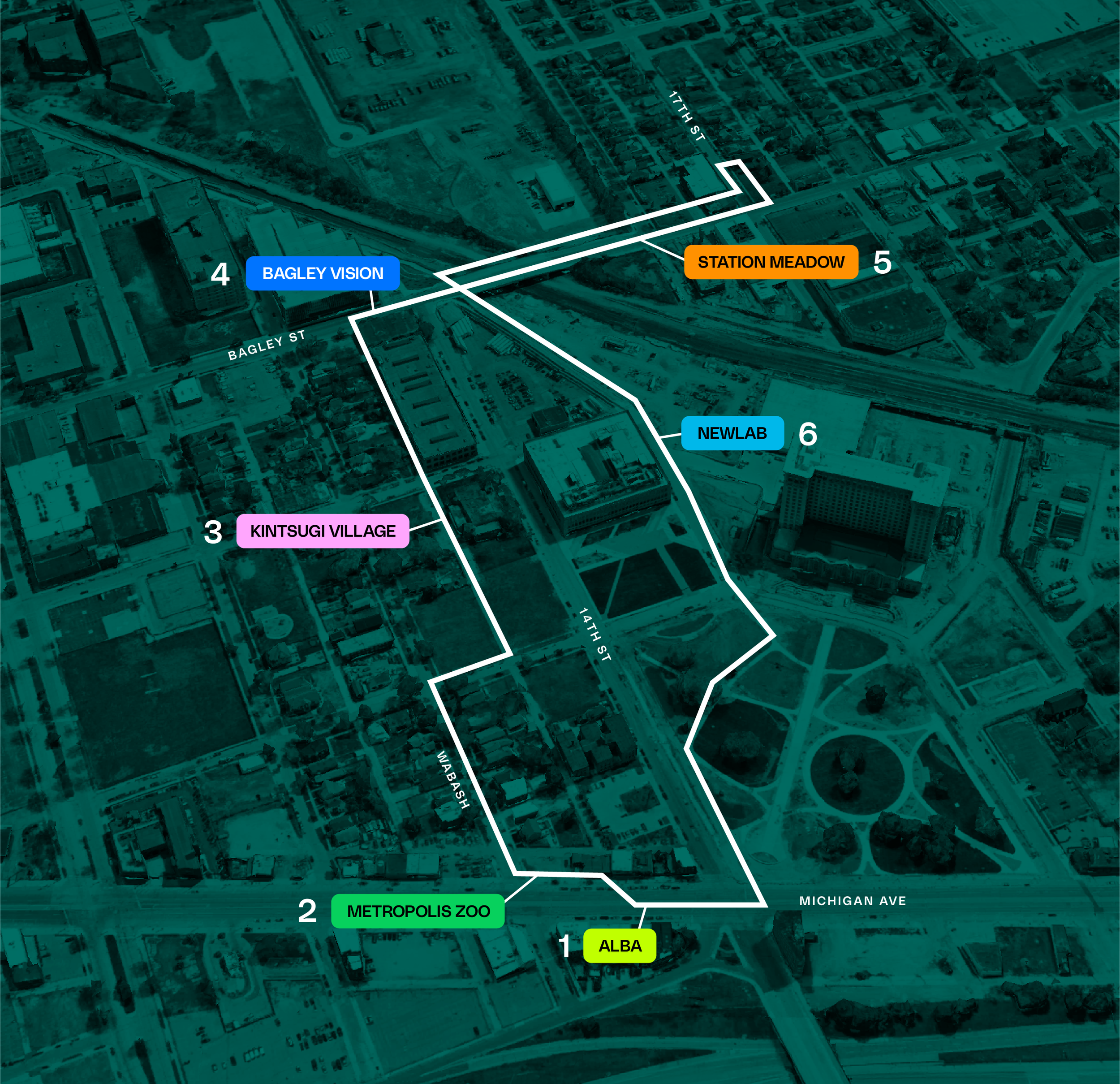
The full loop is 1.3 miles and will take 45 minutes if you walk quickly but we recommend strolling and stopping to linger. We recommend starting at Alba, grabbing a beverage and then walking the loop… or you can explore individual stops at your own pace. For example, in Hubbard Richard, where Station Meadow is located, Tigris and Honeybee are both great spots to grab a bite/beverage while exploring the loop.
The landscapes will continue changing throughout September. Some are established. Others are experiments or works in progress.
At every stop:
Notice: What is growing, moving, changing—or missing?
Feel: What happens to your pace, breath, attention, or mood?
Imagine: What else could this piece of earth support?
Participate: What role could you play?
Stop 01
Alba
2124 Michigan Avenue, Detroit
Abundance in a Small Place
Along one of Detroit’s busiest streets, a small tree box shows how little space it takes to create more life.
More than ten locally sourced plants - including coreopsis, coneflower, butterfly milkweed, and other native flowers - bring color, food, habitat, and seasonal change to this compact corner. Most were sourced nearby at Eastern Market and native plant nurseries in the metro area.
The existing tree is struggling, so Brightside has been improving the soil and monitoring its health as we determine what care it needs next.
Alba’s owner, David, loves plants. You will find them throughout the café, too. The planting outside extends that same spirit into the street.
Pause
Find three colors, two textures, and one sign of life besides yourself. Then look along Michigan Avenue. Where else could a few plants make a difference?
Stop 02
Metropolis Zoo
Corner lot beside Metropolis Cycles
2117 Michigan Avenue, Detroit
Make Room for Wonder
This place is still becoming.
The lot beside Metropolis Cycles has been overgrown and lightly stewarded over the years. Shayne, the owner of Metropolis Cycles, and Brightside came together and thought: Instead of clearing away everything that has emerged, what about if we work with and have fun with what is already here.
Later in September 2026, the biking community and residents will come together to clear edges, create a path, maybe drop some more native plant seeds, and crowdsource animal sculptures to create a playful temporary refuge. A neighbor has already planted sunflowers.
Depending on when you visit, the Zoo may be taking shape - or you may see the site before the transformation begins.
That is part of the experience.
Notice
What has grown here without anyone planning it? What feels wild? What feels neglected?
What could a little care and imagination make possible? What overlooked place near you could become something different if someone simply began?
Stop 03
Kintsugi Village Park
2029 Wabash Street, Detroit
Many Landscapes, One Place
In 2025, Brightside began working with Kintsugi Village to reimagine this one-acre Park property as a place where children, food, community, and ecological life could thrive together.
Today, several living systems share the site.
Pocket Forest
Planted in September 2025 with more than 1,100 native trees and shrubs representing 38 species. Among them is the serviceberry: spring flowers for pollinators, summer berries for birds and people, and changing color across the seasons. This pocket forest came to life through Brightside Collective, SUGi, Lifetime Foundation, and Greening of Detroit.
Mini Meadows
Established in spring 2026 to add flowers, grasses, habitat, and seasonal movement. Creating Habitats for Pollinators is the meadow maker and US Fish and Wildlife provided seeds.
Food Garden
Twenty-six raised beds that provide food to Kintsugi Village events and preschool as well as serve as a teaching garden. This amazing space is designed and currently managed by Featherstone Farms.
Entry Garden
Dozens of native flowers and grasses - including milkweed, coneflower, and bluestem - bring shifting color and texture throughout the growing season. As opposed to having a fence, we are creating a soft, natural perimeter.
The Park Loop
Walk the path 11 times and you have traveled one mile! Along the way, move through forest, meadow, food garden, pollinator habitat, and gathering spaces. Beneath the large cottonwood, take a seat on the colorful circular bench.
Move
Walk one loop slowly. Where does your pace change? Where do you want to linger? What can you hear here that you could not hear on Michigan Avenue? What changes when food, biodiversity, movement, play, and gathering are designed together?
Stop 04
Bagley Vision Courtyard
2150 Bagley Street, Detroit
Bagley + 14th, Corktown
More Life, By Design
Bagley Vision shows what happens when a developer treats landscape as part of the project, not as decoration added afterward.
This adaptive-reuse development gives an existing Corktown building a new life while making meaningful room for trees, habitat, gathering, and everyday encounters with nature.
River birches, serviceberries, shrubs, and layered plantings create the feeling of a small urban woodland. Taller trees were positioned so residents on upper floors can look toward the canopy rather than only pavement and buildings. The berm along 14th and Bagley is covered in rocks, shrubs and trees as opposed to grass - creating more sustainability and permeability.
Wood reclaimed from inside the building has also been given another life as outdoor seating.
The proposition is simple: Development does not have to choose between density and nature. We can design for more of both.
Notice the Design
Choose one thing that could change how the courtyard feels, functions, creates shade, supports life, or invites people to stay. What should the next generation of Detroit development make more room for?
Stop 05
Station Meadow
1600 17th Street, Detroit
Walk The Future
This landscape does not exist yet. Station Meadow is a roughly one-acre rail-owned property being prepared for a new ecological life.
During 2025 and 2026, Brightside and partners have been monitoring soil, managing vegetation, and defining the future walking path. For Month of Design, pinwheels trace that route, allowing you to walk through the idea before the meadow arrives.
Native meadow seed is planned for November 2026 in partnership with US Fish and Wildlife and Creating Habitats for Pollinators. The first new growth will emerge in 2027, and the landscape will continue changing over several seasons.
While you’re in the area, stop by the Honeybee market for a taco and/or grab a beverage and listen to great music at Tigris.
Imagine
Follow the pinwheels. Imagine plants moving in the wind. Pollinators and birds arriving. Neighbors walking, sitting, and gathering. What should this meadow make possible?
Offer one word or intention for its future. Then come back in 2027 and see what the land becomes.
Stop 06
Newlab Detroit + Roosevelt Park
2050 15th Street, Detroit
Question The Default
Your final stop invites comparison.
Around Newlab, trees and layered plantings create shade, texture, habitat, seasonal variation, and a more complex relationship between building and landscape. Beside it sits Roosevelt Park: beautiful, open, and largely defined by expansive mowed lawn.
Neither landscape needs to be reduced to right or wrong.
Lawns can provide gathering, recreation, openness, and visibility. More diverse landscapes can offer cooling, habitat, biodiversity, shade, and seasonal change.
The question is whether we are being intentional about what each piece of land is asked to do.
Compare
Stand where you can experience both.
Notice: temperature, shade, sound, plants, insects and birds, movement, places to gather, how your body feels
What work is each landscape doing? Where could greater ecological complexity create more value for people and nature?
You’ve Walked The Loop!
Living Loop asks us to make those choices more intentional.
Walkability is not only about moving efficiently between destinations. It is also about what we encounter along the way.
Can we find shade?
Hear birds?
See butterflies?
Pause somewhere beautiful?
Meet another person?
Breathe a little deeper?
Feel curious or restored?
A more sustainable city should also help us reconnect—with one another, with place, and with the ecology around us.
Your Piece of Earth
Think about one place you influence:
A yard. A tree box. A business frontage. A school. A development. A vacant lot. A workplace.
What could happen there?
Maybe it begins with:
three plants; one tree; less lawn; a place to sit; a pathway; habitat for pollinators; letting one area grow differently; asking a landowner a question; or deciding an overlooked place deserves attention.
You do not need to transform the whole city to participate in its future.
Start with one piece of earth.
Now Look Again
You have moved through:
a tiny business tree box;
an overgrown lot becoming playful;
a pocket forest, meadows, and food garden;
a developer-designed courtyard;
a meadow still waiting to grow;
and two contrasting approaches to urban landscape.
Different scales.
Different owners.
Different stages of transformation.
But one idea connects them: Every piece of earth is already making choices about what kinds of life it can support.